Loren Muse
The InnocentLoren Muse is an Essex County homicide investigator whose investigation repeatedly forces her to reconsider what appears to be an obvious answer. She follows connections among an unidentified dead woman, Matt Hunter, and a wider chain of crimes, eventually going to Reno at personal risk. Alongside that case, the novel follows her unresolved grief over her father’s suicide, a family wound that comes into focus in the final scene with her mother.
Identity and Background
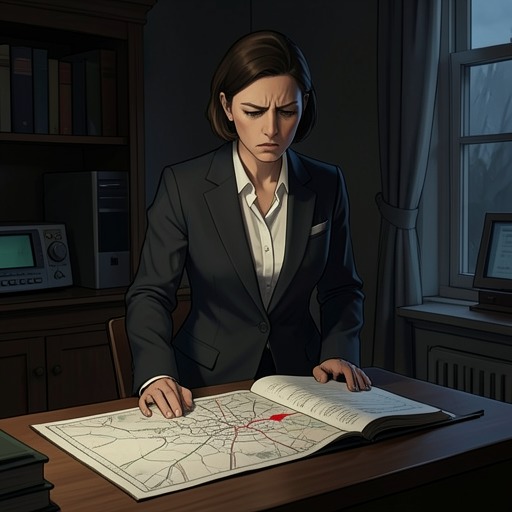
Loren works as a homicide investigator for the Essex County prosecutor’s office. When prosecutor Ed Steinberg tells her that a dead nun had breast implants, her surprised response makes clear that the case is already unsettling ordinary expectations about the victim’s identity. Her work requires her to pursue facts that do not fit neatly into an initial account.
Her past is marked by her father’s suicide. As an adult, Loren believes he may have been bipolar and understands his death in terms of a possible chemical imbalance; she also recognizes that it is unfair to assign responsibility for a suicide to other people. Yet she has blamed her mother, Carmen, and wondered whether her father might have lived had he married someone else. That explanation is not a settled judgment so much as a grief-driven question Loren has carried into adulthood.
After her father died, Loren rebelled. She drank, smoked, spent time with people she regarded as the wrong crowd, and had multiple sexual partners. She recognizes the gendered double standard that praises men for behavior used to shame women, but she also admits that her own choices were connected to low self-esteem. The narrative thus presents her self-awareness as complicated rather than triumphant: she can identify the unfair social judgment and still see the personal vulnerability beneath her actions.
Investigative Work and the Hunter Case
Loren’s work in New Jersey brings her into the investigation of a woman whose real name is unknown. She tells Joan Thurston that investigators have three dead people in the case and that the first victim’s identity remains unresolved. The investigation has links to Matt Hunter, a local man from Livingston whose earlier college-party case had attracted newspaper attention. Loren identifies him as an ex-con and becomes intent on tracking him down.
Her pursuit of Matt draws on both professional necessity and a personal connection. She and Matt knew each other long ago at Burnet Hill; when she cannot reach him at his law firm, she calls his home and leaves a message identifying herself as an investigator and reminding him of their shared past. The call makes the old acquaintance part of the present investigation without resolving whether it will help or hinder her efforts.
Loren also questions how much can responsibly be inferred from a person’s past. While talking with Lance Banner, she considers a possible investigative profile, but recognizes the limits of drawing conclusions from something as slight as how someone played on monkey bars as a third-grader. She returns to the practical task of finding Matt, setting out for Lockwood Corp. in Wilmington and trying him by phone. The episode shows her testing a theory without mistaking speculation for proof.
As the case expands, the apparent explanations repeatedly fail. Loren sees that Max Darrow being outmaneuvered by a prostitute and Charles Talley’s death appearing to fit a jealous-husband scenario do not account for Emma Lemay, the Nevada FBI, and the other connections she has uncovered. The case’s accumulating links make certainty dangerous: an explanation can seem complete and still leave essential facts unexplained.
Choices, Risks, and Relationships
Loren’s contact with people in the case is shaped by her investigative role, but it is not impersonal. When she sees Matt’s sister-in-law’s house, Lance invites her into his car and drives around the old neighborhood while asking why she wanted to speak with the woman. The conversation places Loren’s inquiry within a network of family and local history, while her response to Lance remains directed toward the central objective of locating Matt.
Her decisions eventually take her beyond the cautious route Steinberg would prefer. Loren flies to Reno by way of Houston using her own money. She knows that this choice could cost her her job and force her to leave for somewhere such as New Mexico or Arizona; she also understands why Steinberg needs to proceed more strictly by the book. Even so, she concludes that the facts require her to act. The trip is therefore both an investigative commitment and a professional gamble.
In Reno, Loren intervenes when Cal Dollinger is attacking Matt. She identifies herself as a police officer and orders Dollinger to freeze and drop his weapon. The intervention breaks Dollinger’s hold on Matt and gives Matt a brief chance to recover. Later, when Matt cannot get out of bed and tells Loren to go, she radios the Reno Police Department and runs to her car. Her conduct remains active even when the danger is no longer confined to the immediate confrontation.
Loren also recognizes Adam Yates’s plan to arrange a fatal confrontation and conceal the truth. When Yates speaks of himself and Cal dying in the line of fire, Loren understands what he is about to do and panics, trying to stop him. Her response is not merely the collection of evidence after the fact: she sees the danger as it is being set in motion and attempts to intervene.
Grief, Family, and Ending
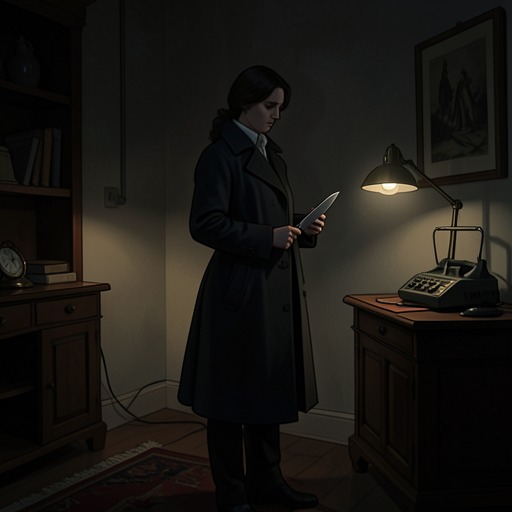
Two days later, Loren is back in her garden apartment, making a ham-and-cheese sandwich while her mother sits in the next room watching Entertainment Tonight. The ordinary domestic scene gives way to a private breakdown: Loren begins to cry silently, waits until the sobs pass, and calls out to Carmen. The restrained details make the grief arrive not as a public declaration but in the pause between a household task and the words she can finally say.
Loren tells Carmen that she had blamed her because otherwise she did not know how to understand what happened. Then she asks why her father did not love her enough to want to live. Carmen answers softly, but the passage does not supply a simple resolution to the question. Loren’s accusation exposes the child’s logic beneath the adult investigator’s understanding of possible bipolar illness: knowing that suicide cannot fairly be assigned to another person has not erased the feeling that her father’s death was a rejection of her.
The novel ends this thread not with a definitive explanation of the father’s death but with Loren voicing the hurt she had converted into blame. Her mother’s presence allows the question to be spoken directly, but does not make it answerable. The shift is significant: Loren moves from privately assigning fault to asking for recognition of the pain beneath that assignment.
Narrative Role
Loren’s investigative arc gives the murder plot a perspective that remains alert to the gap between a plausible explanation and a proven one. The supposed jealous-husband scenario, the uncertainty about the first victim’s name, and the far-reaching Nevada connection all demonstrate how quickly a case can outgrow its first coherent story. Loren’s acknowledgment that a theory can make perfect sense and then collapse establishes doubt as part of her method rather than an obstacle to it.
Her private history provides a parallel, but not an equivalent, form of investigation. At work she tests connections among people and deaths; in the closing family scene she confronts the meaning she has attached to her father’s suicide. The narrative lets these strands meet through her capacity to revise an explanation: she recognizes the limits of profiling and the unfairness of blaming others, yet must still give voice to an old and painful question. Her final exchange with Carmen leaves the grief unresolved while making it newly speakable.